
MANJUU
For over twenty years, Manjuu has traveled across Japan with dolls, cameras, and heavy bags full of equipment — searching for landscapes that feel both real and dreamlike. His photography balances technical precision with quiet emotion, turning ordinary locations into deeply atmospheric scenes filled with memory, light, and subtle storytelling. In this conversation, he reflects on artistic change, the role of AI, the physical realities of outdoor photography, and why, even after all these years, he still feels compelled to keep creating.
Since our 2021 Figubo interview, how would you describe the development of your photography?
I can’t believe it’s already been 5 years since 2021. Time really flies fast, doesn’t it? In terms of my development as a photographer, I’m not sure if I can give myself a passing grade. However, thanks to my deep love for doll photography, I’m working at a doll company now. I am incredibly happy that my hard work has been recognized and is actually helping me make a living.
My job’s main focus isn’t on taking photos, but I’m actually happy about that. Doll photography remains a vital element of my private life, and having this sort of balance in my life is what keeps my passion alive and allows me to keep going.
Sometimes I ask myself, “Hey, Manju. You’ve been photographing dolls for at least 20 years now. Why not take a break?” Especially since there are so many talented photographers out there these days, even if I stopped, maybe nobody would miss me.
But still, I feel the need to create something and share it with everyone. Last year, at Comic Market 106 in Japan, I finally published my very first photo collection. And this summer, at Comic Market 108, I’m planning to release a second one. At the moment, I’m working on putting it together.
What aspects of your style have remained consistent, and what has changed over the past few years?
I have continued my creative work throughout these past five years, of course. If I were to pinpoint what has changed, it would be my adoption of AI for post-processing and my increased focus on photographing dolls based on characters from anime and video games.
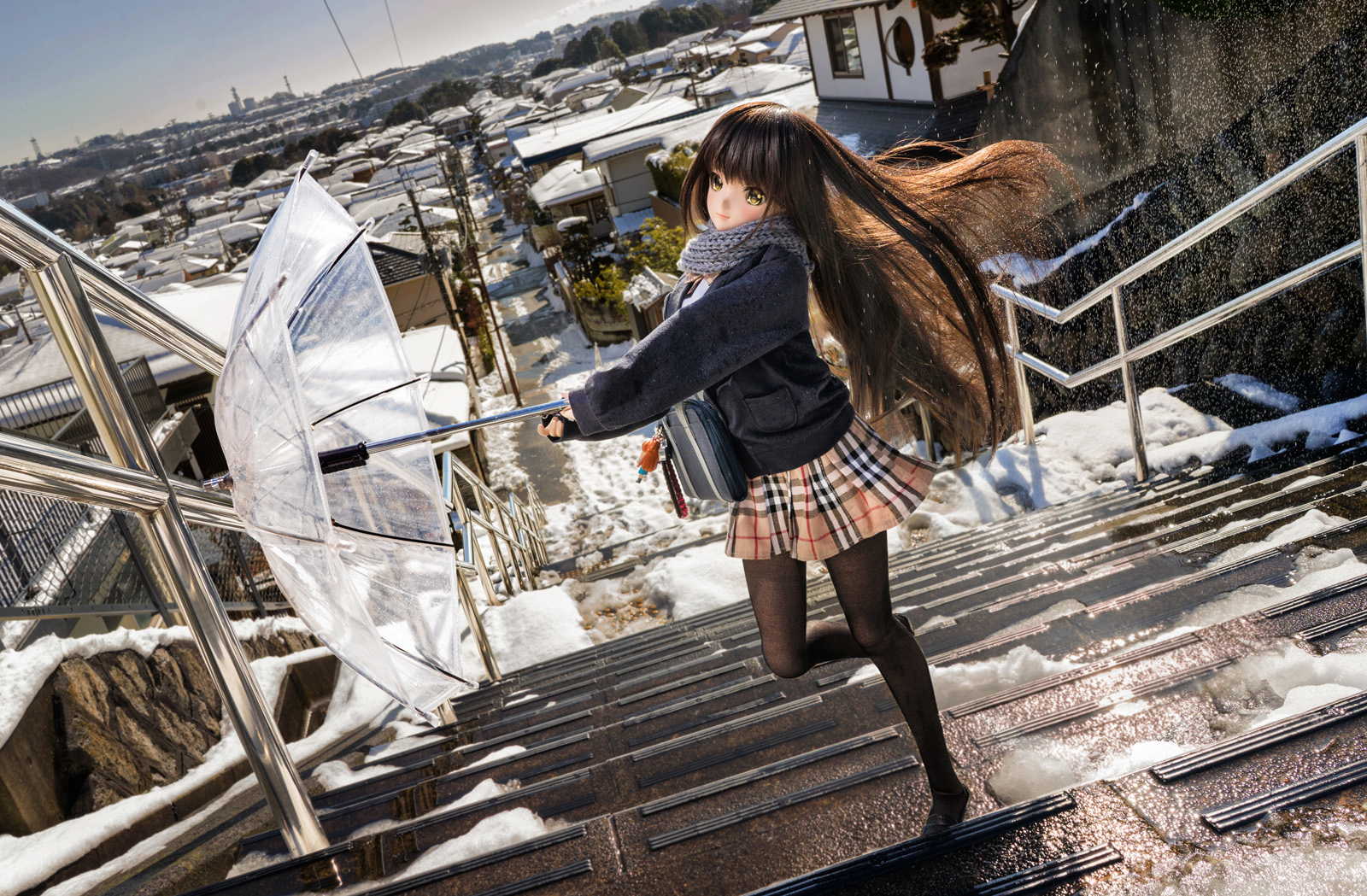
My feel for composition has changed as well. In the past, I favored grand, breathtaking landscapes, often making the character blend into a vast scenery and making them take up comparatively less space. Nowadays, my style has the character occupy a much larger portion of the frame, with the background acting more as a way to make the doll stand out. This is connected to my habit of meticulously adjusting the doll’s musculature and skeletal structure during post-processing to achieve an ideal result. By enlarging the character, I hope to draw the viewer’s eye to these specific details that I want to emphasize.
Some might think, “Didn’t you love placing dolls in beautiful scenery?” I want to assure you: I still love doing exactly that. For that same reason, I do my best to feature expansive backgrounds even now. My sincere wish is for viewers to feel as though they are traveling with me to the places I’ve visited. Five years have passed, I am now over 40 and my eyes aren’t what they used to be, but I still head out for shoots carrying dozens of kilograms of gear. I truly hope the scenery I capture makes these trips worth every bit of effort.
Have your goals as a photographer evolved since 2021?
Up until 2025, my primary goal was to publish a photo collection of my own. Last year, I finally managed to achieve that milestone.
Now, my new goal is to keep photographing until I’m 50. I am 42 now, and every time I head out, the gear feels like it’s getting heavier and heavier, ha ha. I don’t own a car, so I rely entirely on public transportation for my shoots. While public transit in Japanese cities is incredibly convenient and reliable, my photography usually takes me into the countryside. This means I often find myself hiking up mountains or walking long distances with heavy gear on my back. However, it has its benefits too. I see it as a great opportunity to get some exercise!
How do you approach location scouting and preparation today?
IWhen I need to find out if a spot is suitable for a shoot, I rely on two main tools: Google Maps and X (Twitter).
Without Google Maps Street View, researching new locations would be incredibly difficult. It provides vital information: is there a background that fits my vision? Do many people walk around? Is there enough space to set up my doll and tripod? Being able to confirm the last part beforehand is especially crucial. Things that used to require a physical trip can now be confirmed on your phone or computer screen. Thanks to the extensive coverage of Street View in Japan, I can check not just the site itself, but the paths leading there, the entrances, and even parking availability. Without the convenience this provides, traveling to distant locations for a shoot would truly be an “adventure”.
On X, I often find inspiring photos that pique my interest. I’ll then look them up and mark them on my Google Maps for future trips. Additionally, since many people in Japan use X as a personal diary, I can use keywords to see real-time photos of a location. This is incredibly helpful for seasonal subjects like cherry blossoms. I can confirm whether the trees in a specific area are in bloom and how crowded it is there without even leaving my house. Since doll photography can sometimes draw unwanted attention, aiming for locations and times with fewer people around is an important part of the process.
As for my gear, I usually carry the following: Camera (plus spare batteries and memory cards), lenses, flash color filters, wireless flash trigger, shutter release cable, two flashes (plus batteries), two travel tripods, a mini tripod, tripod extension pole, a 4-way (opaque, black, white, gold) reflector, a folding chair, an umbrella with a silver interior, doll stands, various clips, wire, and flexible pop clips.
I particularly recommend the silver-lined umbrella and the folding chair. The umbrella provides the same function as a studio umbrella, but is a real umbrella, so it provides shade in the summer or protection from rain. I bought mine in Taiwan and have used it for over ten years without it breaking. The folding chair is a lifesaver during setup and shooting, since it keeps you from having to crouch constantly. Your ankles will appreciate that! Moreover, a lower vantage point allows you to get a better grasp on the relationship between the doll and the background. It’s much easier to get the angles right when you’re sitting at the doll’s level rather than standing up and looking down.
FROM IDEA TO LOCATION
My sincere wish is for viewers to feel as though they are traveling with me to the places I’ve visited.
When creating a new image, what usually comes first — the concept, the location, or the doll itself?
That is a truly great question. Outdoor photography requires you to think about many variables: the doll’s outfit and props, the landscape, lighting and weather… Sometimes, there is already an idea I have in mind beforehand. However, if you wait until you have a clear vision before you start looking for a location, you’ll often find yourself running out of time.
For me, the first step is usually saving potential locations in my Google Maps. I make sure to write down detailed notes about each spot. Is it better for day or night shots? What kind of scenery is it? I even include reference photos taken by others. I mostly gather this information from X (Twitter) or YouTube. By building this database of locations in advance, I don’t have to waste time searching for a spot once an idea strikes.
Beyond that, I often build my compositions around small props. In Japan, countless new capsule toys are released every month: miniature bread, cola cans, candies, snacks and so on. I often browse shops to see if there’s anything that could work for a doll shoot. Another vital thing is to attend doll events. In addition to outfits, you can find so many charming accessories there. If you ever feel that your doll’s poses are getting repetitive, I recommend starting with a prop. Try to think up a reason for your doll to be holding that specific item. How does it interact with the environment or with other characters? Thinking this way can open up a whole new world of inspiration.
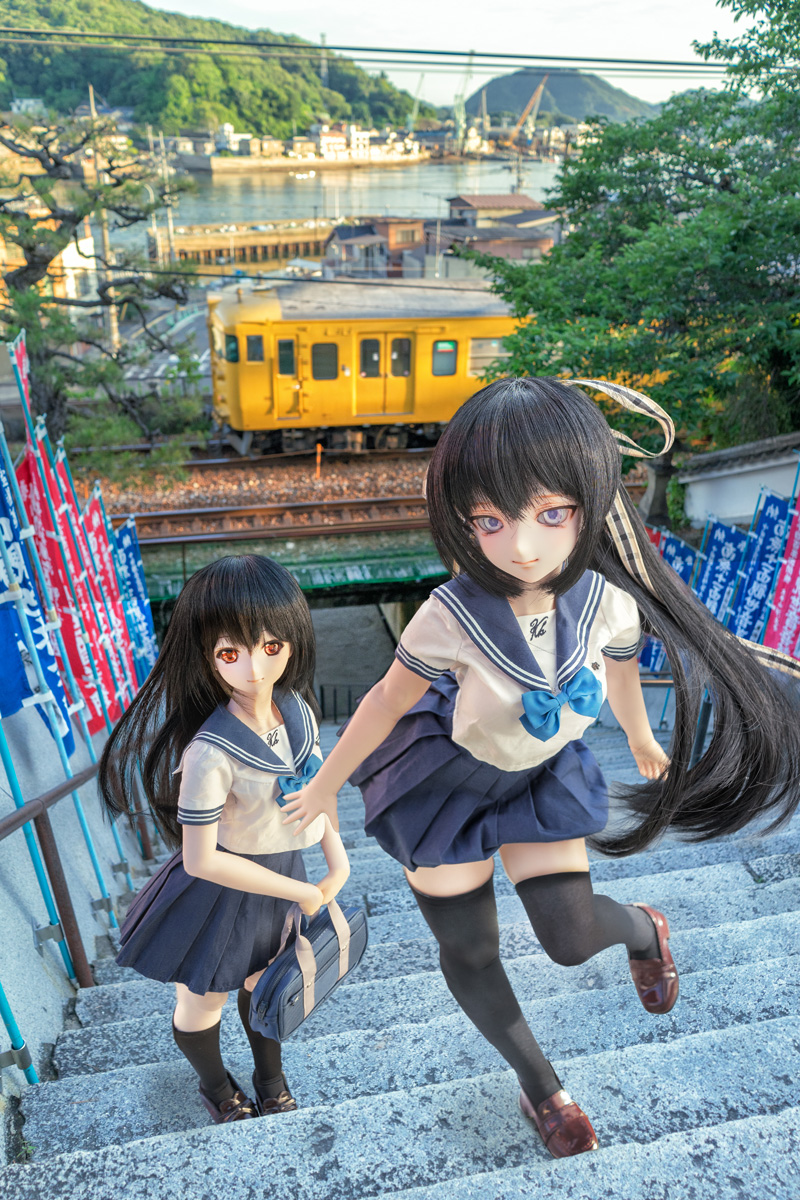
Do you plan your images in detail beforehand, or do you allow space for spontaneity during the shoot?
If I already have a specific composition in mind beforehand, I adjust the contents of my luggage accordingly. If I don’t have a specific idea, I first research the location using Google Maps or X, as I mentioned earlier, and then prepare the doll heads, wigs, outfits, and props that seem to fit that setting.
You might wonder, “Only the heads?” Well, since I don’t own a car, the amount of luggage I can carry while traveling is extremely limited. The camera, lenses, and tripods alone exceed 10 kg. For a three-day, two-night trip visiting two or three locations per day, the remaining space in my bag usually fits about two or three doll bodies, five heads, four wigs, and five or six sets of outfits, shoes, and socks, along with other accessories and props. Every time I go on a long trip, my luggage is packed to its absolute limit. Because the number of doll bodies I can carry is limited, I switch out different heads, outfits, and wigs depending on the place.
Once I arrive at a location, I pose the doll to fit the final composition and lighting. However, in my experience, planning the composition in advance usually leads to more satisfying results. It also saves a significant amount of time during the actual shoot.
Learning how to capture light and shadow is a lifelong journey for every photographer.
Has your equipment or workflow changed since our last interview? If so, how?
What a coincidence – I have just completely overhauled my camera and flash system. Previously, I used a SONY A7II with SEL28F20 (28mm) and SEL50F14Z (50mm) lenses, along with a CANON EF70-200mm F4L USM. Toward the end of last year, the LCD screen on my camera broke, and my long-serving budget flash finally stopped firing. Consequently, I upgraded to a SONY A7CII, replaced my flashes, and purchased a wireless flash trigger with TTL support.
I am still experimenting with lighting methods with my new flashes, but the impact of switching to a new camera was dramatic. First of all, the A7CII handles underexposed areas beautifully and with rich details, and thanks to that, I no longer have to rely heavily on flashes or reflectors to eliminate unnatural shadows on the doll’s face or body. This means I can often get the perfect shot without a flash, or with just a light touch of a reflector, which significantly reduces my shooting time. It also performs much better with backlight present, allowing me to approach the challenge of backlight shots with more confidence.
Another major change is the autofocus. Previously, I only used manual focus. However, the new camera’s autofocus can precisely lock onto a doll’s eyes. This allows me to shoot handheld rather than having to set up a tripod every single time. It’s a huge advantage in cramped spaces where a tripod simply won’t fit.
My old workflow used to be: decide on the background composition, set up the doll, fix the tripod and focus manually, then adjust the lighting. Now, I can often just set up the doll and shoot handheld with a simple reflector. Of course, depending on the weather and lighting conditions, the process can still get a bit more complex, but I have gained much more flexibility.
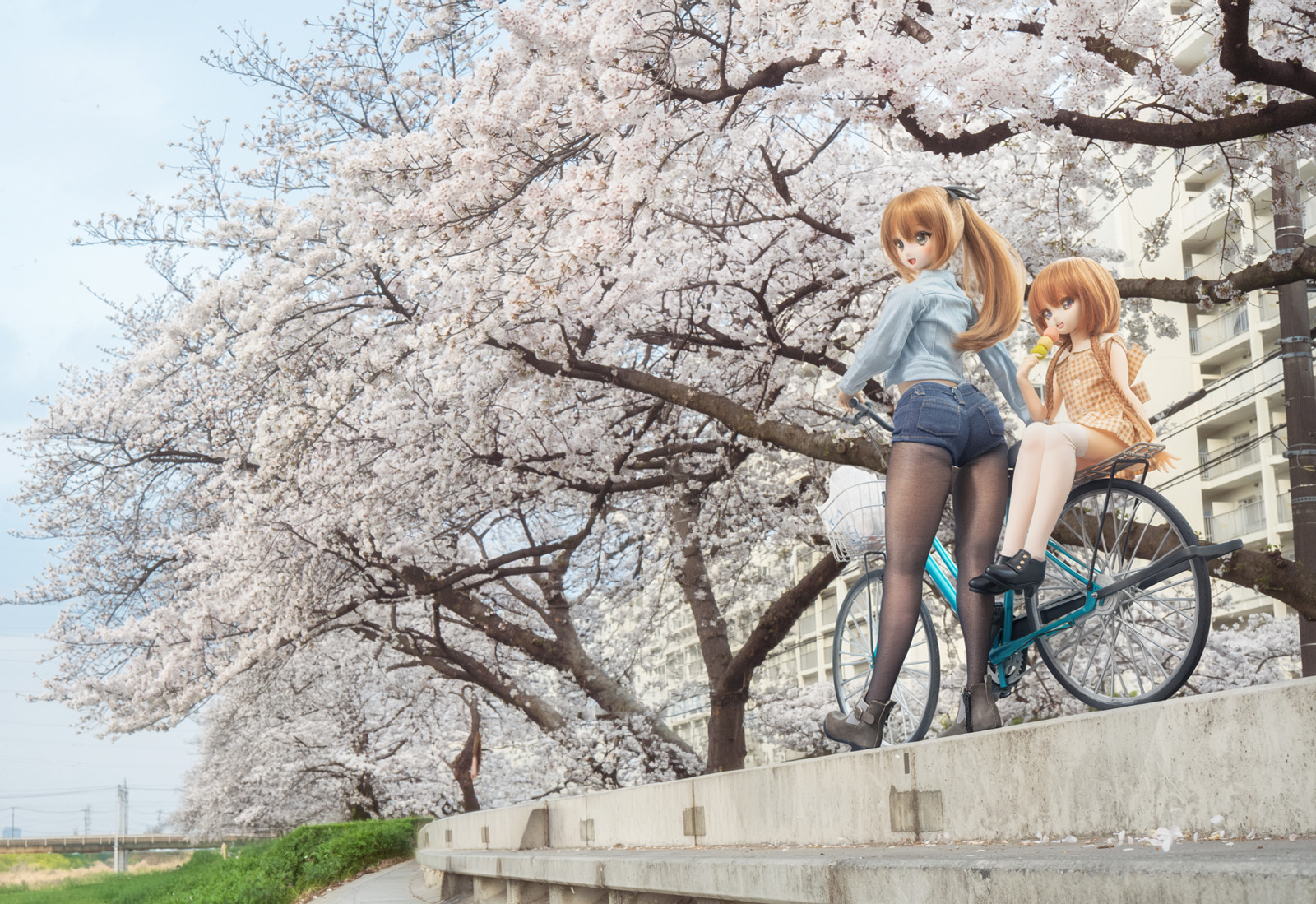
What do you currently consider the most technically challenging part of your photography?
Learning how to capture light and shadow is a lifelong journey for every photographer. Personally, I feel I still have a long way to go. This is far more important than any of the equipment I mentioned earlier. If someone wants to photograph dolls but doesn’t want to spend a fortune on DSLRs, flashes, or tripods, my advice is simple: “Set up a few pieces of foam board around your doll, light it from above with a desk lamp (or ideally two), and just use your phone.” This alone provides a beautiful lighting. To be honest, many people buy expensive cameras only to end up with nothing more than photos with blurry backgrounds. Having expensive gear doesn’t mean you don’t have to learn how to work with light and shadow.
Outdoors on a sunny day, you might need to use the translucent part of a reflector to cut the light while using a flash to ensure the doll doesn’t disappear into the shadows. On the other hand, on a cloudy day the sunlight is soft and diffused, so a flash isn’t usually necessary; however, a lack of shadows can make the doll look flat, as if it’s not really a part of the scene. It ends up looking like you just placed your doll in front of a giant TV or monitor. When you’ve traveled a long distance, it’s a bit tragic if the final image looks pretty much the same as the one you took at home. Expressing the right balance of light and shadow not only adds tension to your photos but is a vital element in making the doll blend naturally into the background.
I personally recommend practicing with light and shadow at night. For example, you might try shooting on a city street with office buildings or a lit-up bridge. Because the environment is dark, the effect of your flash will be much more prominent than during the day. You have to find that sweet spot where the doll isn’t too dark but still blends into the background well. It takes a lot of trial and error, but there is no need to hurry. Unlike at dusk or when the sun is shifting behind clouds, light at night is man-made and therefore very stable. As long as the streetlights or surrounding lights stay on, you can keep experimenting until you’re satisfied. Plus, you don’t have to worry as much about onlookers. However, when shooting at night, don’t forget that it can get unsafe depending on the country, location, or even your gender. I strongly advise putting safety first—especially for women, please reconsider going out alone at night.
How important is post-production in your overall creative process?
Some might believe that the less editing a photo requires, the bigger proof of a photographer’s skill it is. On a fundamental level, I agree with them. However, there are certain things that simply cannot be achieved without relying on post-production. In my photos, you usually won’t see the ball joints of the dolls. Furthermore, while I use bodies like VOLKS’ DDDY and MDD or DOLLBOT’s DBC, the actual silhouettes in my images slightly differ from the original products. This is because I feel a strong need to accurately capture the beauty of female curves and to recreate my ideal physique. To be honest, this isn’t the most practical approach, as it means every single photo requires some degree of retouching on the doll’s body. I also make adjustments to the background if something feels logically inconsistent with the composition. For instance, when shooting a doll together with flowers, I might remove surrounding plants that clutter the shot too much. And if the flowers aren’t lush enough, I might increase their numbers a bit.
My typical workflow involves an initial pass in Lightroom to adjust light, tone, and detail. Then, I move to Photoshop to reshape the doll’s body and hide the joints. Finally, I do one last pass to balance the overall tone and lighting.
In the past, I did all of this manually, but now the use of AI has become inevitable. Currently, I use Photoshop’s “Generative Fill”. It doesn’t have the power to produce universally perfect results, but it can take specific parts and make them look more natural. I view AI as a helper to reduce my post-production time, not something I surrender the entire creative process to. The areas I allow AI to handle are the same ones I used to fix by hand. I’ll delve deeper into my thoughts on AI in the next question.
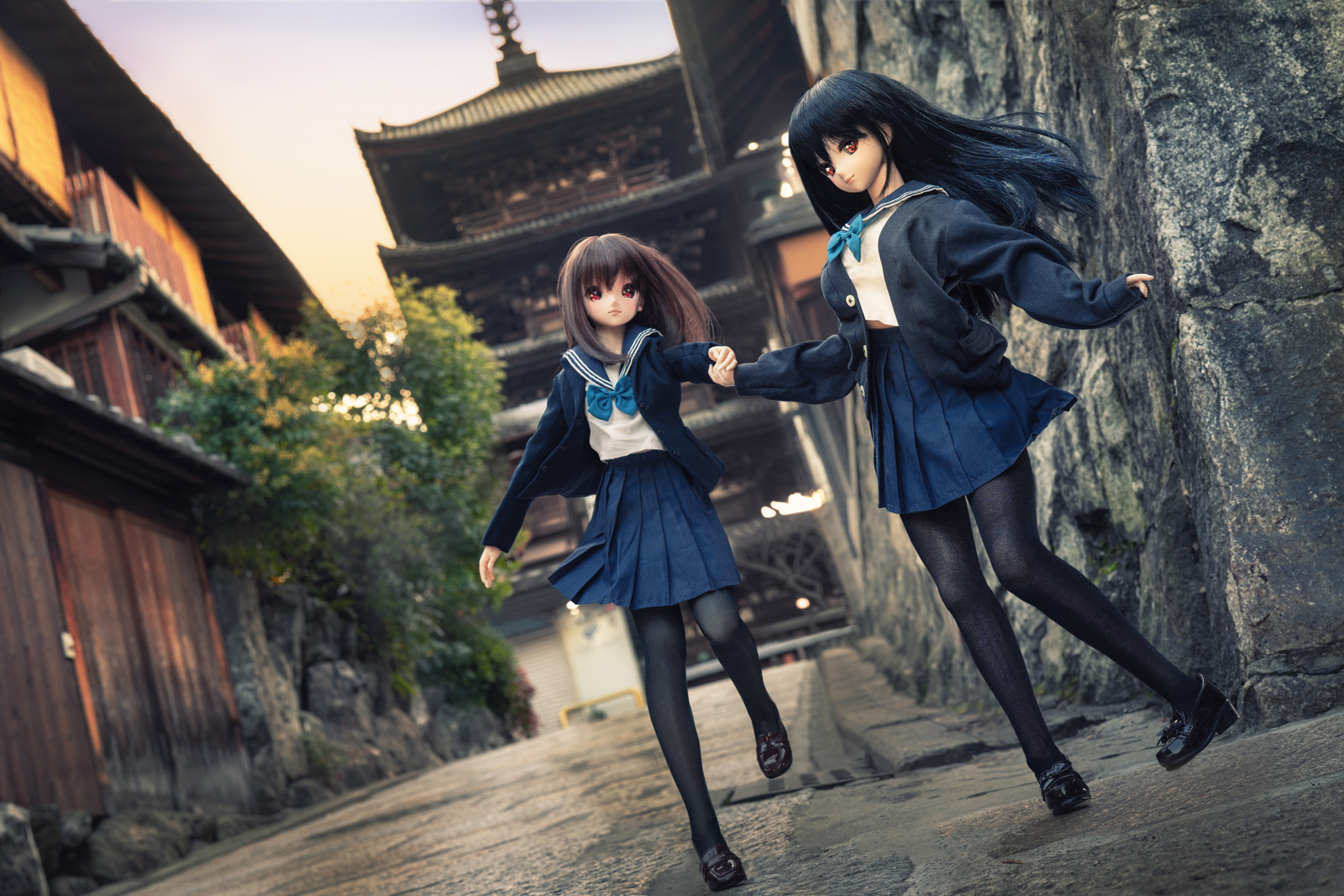
How do you perceive the current state of doll photography today — both in Japan and internationally?
Strictly speaking, there aren’t that many doll owners to begin with, and even fewer take up photography – especially outdoor photography. While the outdoors offers infinite backgrounds and natural light far more powerful than any flash, lugging around dolls and heavy equipment is exhausting. In Japan, if people get tired of shooting at home, they have the option to use rental studios. These spaces provide various ready-made backgrounds and professional LED lighting, allowing for a comfortable shoot away from the wind and rain.
I’ve also noticed a growing trend of people using AI to generate backgrounds. Someone can photograph a doll at home and then tell the AI to place it in a beautiful flower garden or at the beach – or even make the doll surf or eat. AI’s handling of light is getting so sophisticated that I sometimes think: in about two years, no one will bother looking at my photos anymore.
This reminds me of how the profession of painting lost its dominance during the 19th and early 20th centuries as photography advanced. Today, it seems to be photography’s turn to be challenged by AI. However, as we know, painting was never fully replaced. Once painters weren’t required to perfectly record reality, their style evolved and eventually gave birth to movements like abstractionism, creating works that photography couldn’t replicate. These paintings didn’t try to capture reality as-is, instead they expressed the artist’s inner vision and emotions. If you look at impressionist works, such as those by Claude Monet, the light and shadow he depicts are impossible to capture with a camera. Theoretically, an object should have a shadow on one side, but Monet might add a soft light there, as if using a reflector. It might not be exactly realistic, but to our eyes, it certainly is incredibly beautiful. Today, we photographers use flashes or LEDs to express our own inner visions. If AI is a massive database – a collection of “correct” answers – then I believe a “Picasso of the photography world” will eventually emerge to break from that very mold of what is “correct”.
Of course, not everyone can be a Picasso. Putting artistic philosophy aside, I believe doll photography will persist as a hobby. Many of those whose only goal is “beauty” or “cuteness” will likely switch to AI entirely. There will be no reason for them to go outside, and photography studios might disappear. However, I think that in the future, photography itself will become a kind of meaningful experience for us. It will be about traveling to various places with your beloved doll and sharing a favorite environment with them; the act of taking the photo might become secondary.
To me, my dolls are important “partners.” I walk across the land with them to create our works together. Each piece represents memories of a real place I’ve visited, not something fabricated by an AI. This gives me a profound sense of achievement. Despite all this, I’m not entirely against AI. When I eventually get too old to go out or if I ever become ill or injured, I might rely on AI to create backgrounds. In those situations, AI should prove to be a valuable help.
To me, my dolls are important ‘partners.’ I walk across the land with them to create our works together.
Are you currently working on any projects or ideas that you would like to develop further in the coming years?
On a very personal note, I’m hoping to buy my own home within the next few years. I don’t exactly have a lot of money to spare, but if I could build a few private studio sets inside the house, I believe it would be a huge asset to my future photography.
Another project I have in mind is to publish a photo collection featuring a few photos from each of Japan’s 47 prefectures. There are still a few prefectures I haven’t visited yet, but I actually just traveled to Miyazaki Prefecture in Kyushu this month. There are only a few “unexplored” prefectures left on my list now. I just need to keep pushing forward and give it my all to complete the journey.
BEHIND THE IMAGE
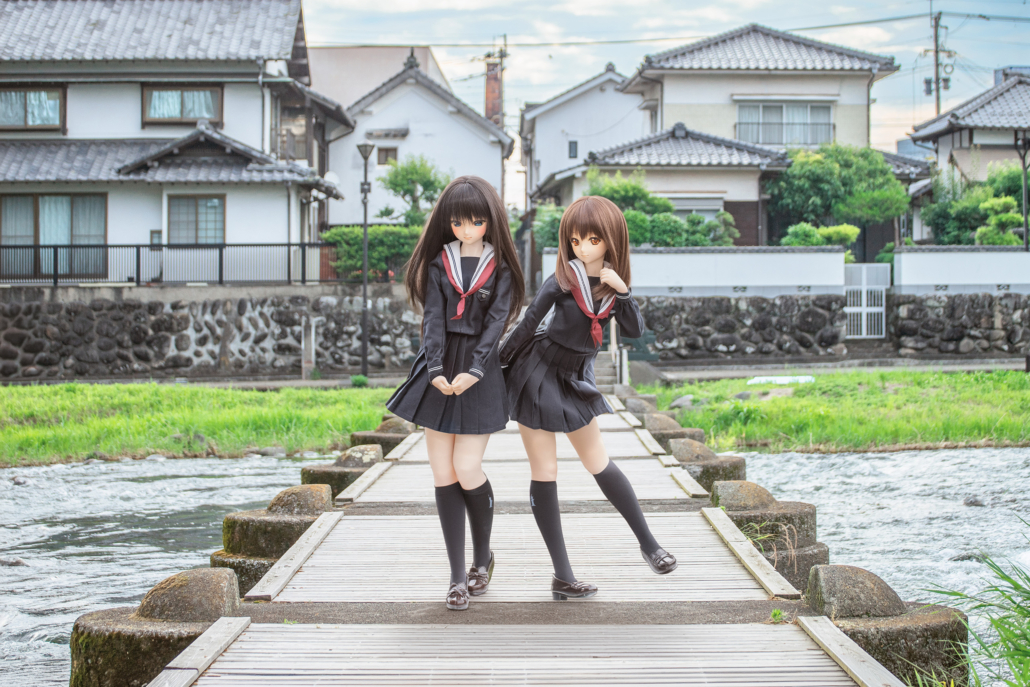
Set on a quiet bridge in rural Kyushu, this photograph brings together many of the qualities that define Manjuu’s work today: careful location scouting, subtle storytelling, natural light, and an almost invisible blend between reality and post-production. In this Behind the Image feature, he shares the technical and creative process behind its creation.
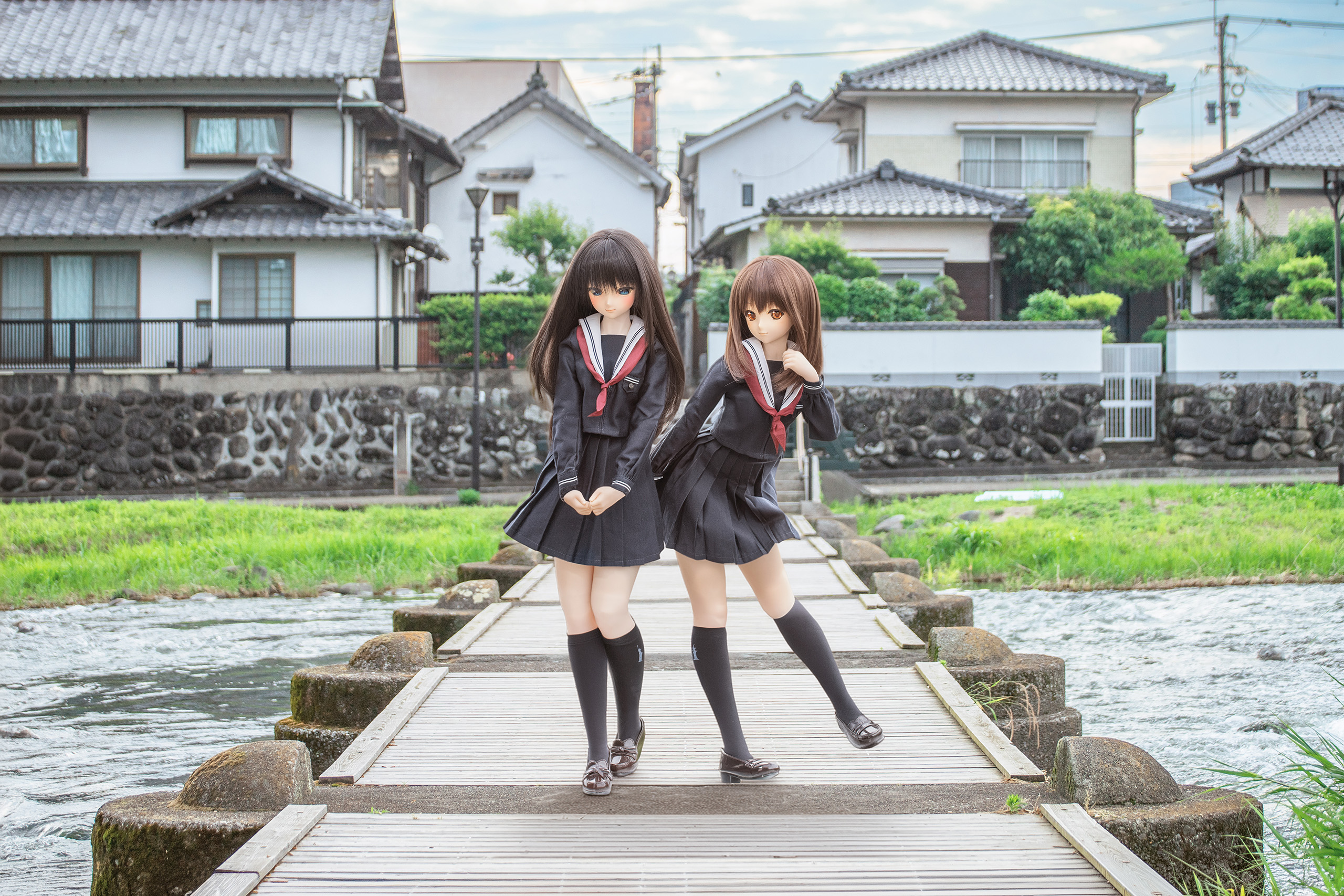
What was the original idea behind this image?
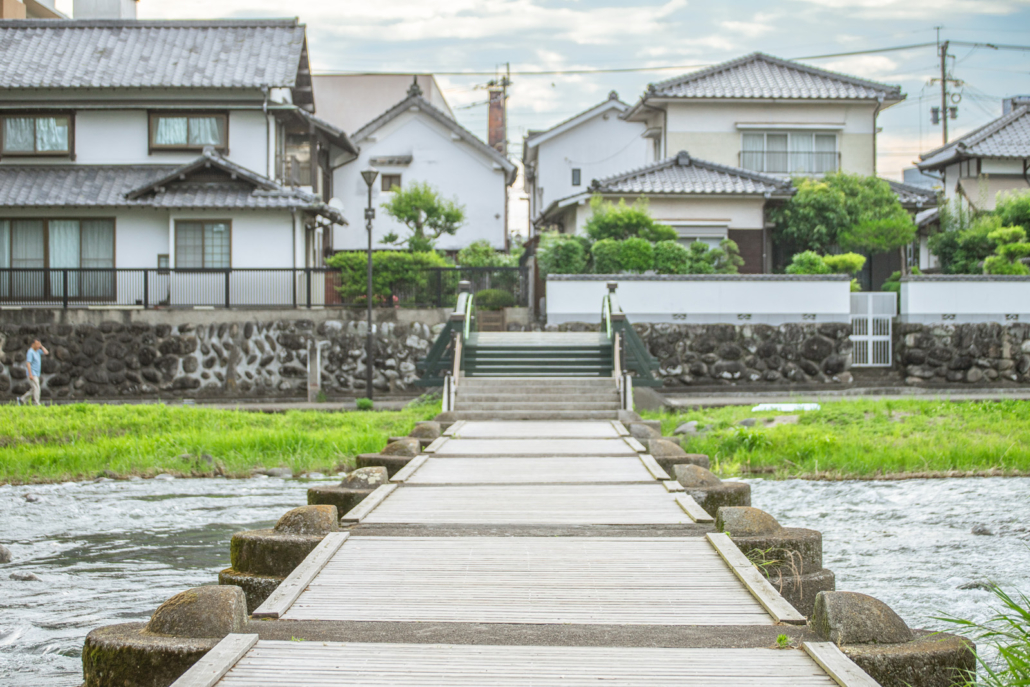
This photo was taken in Hita City in Oita Prefecture, Kyushu, Japan. You can find almost the exact same viewpoint on Google Maps Street View. Two female students in school uniforms blending into the rural landscapes of Japan is one of my most frequent themes and I’ve done numerous shoots like this before.
However, while I usually shoot dolls wearing classic white tops with navy skirts, this was my first time using black sailor uniforms. Compared to the previous shoots, black is a darker tone, making it more challenging to evoke an impression of youthful radiance. I also chose a longer skirt length to give the girls a more modest and calm look. Because of this, I wanted to use a bright background to make the figures – with their high proportion of black – stand out. Regarding the composition, rather than framing the scene as a cheerful conversation between the girls (as I usually do), I felt that these black uniforms are better suited for a different kind of a story – the girls engaged in a mysterious, confidential talk. The girl on the left looks a bit shy, while the girl on the right appears more lively. The girl on the right seems to have said something that made the other blush, but we don’t know the content of their conversation. I invite you to imagine what kind of secrets they are sharing.
How did you prepare for this shoot?
The shoot took place in June 2025. I had originally planned a trip to Oita Prefecture, a place I had never visited before. Oita is located in the northeastern part of Kyushu. Since it is pretty far from Fukuoka, the biggest city on Kyushu, there aren’t so many tourists and transportation can be somewhat inconvenient. However, JR Kyushu has many train lines that start at Oita Station and connect to various small cities in all directions. I don’t own a car, and since I love riding Japanese trains and enjoying the scenery along the way, I mainly used JR Kyushu to travel between various spots on this trip. Because the trains are somewhat infrequent, I didn’t arrive in Hita until after 8:00 PM. I had to head back to the station at 7:00 AM the next morning to continue my journey. I had to pack my stuff and only managed to sleep after 11:00 PM, but the next day I woke up at 5:00 AM. This was partly to ensure I had about two hours for photography and partly to avoid the prying eyes of people walking by. Actually, the background of the photo shows the inn where I stayed the night before. If it hadn’t been so close to the shooting location, I would have been even more exhausted.
Why did I choose this specific spot? It’s because while scouting on Google Maps, I noticed that this bridge has no handrails on either side and this detail drew my attention. The reason there are no handrails is that when the river (Mikuma River) rises due to heavy rain upstream, the water level often exceeds the height of the bridge. Handrails would catch drifting wood and debris, so they are intentionally omitted. This is known as a subsidence bridge, meaning a bridge designed to be able to sink underwater. The lack of handrails creates a kind of a visual illusion, which makes it harder to perceive how small the dolls actually are. If there were handrails, you would know exactly how wide the bridge is, which would make the real size of the dolls obvious.
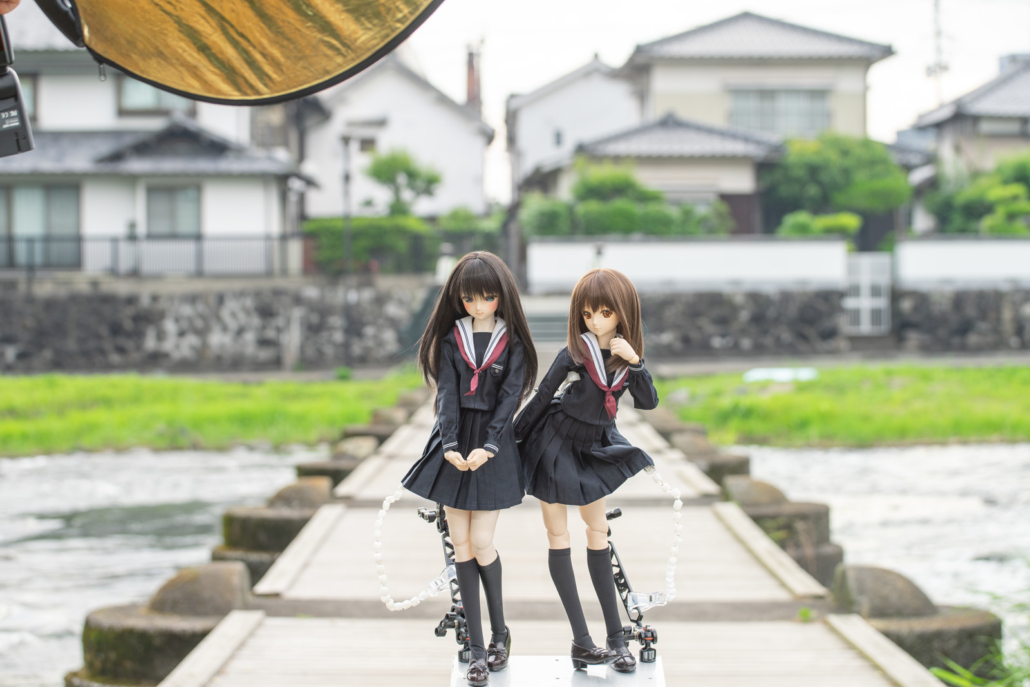
However, once on-site, I realized that if I placed the dolls directly on the bridge, I wouldn’t be able to capture the river even if I set the camera almost on the ground. The composition wouldn’t tell the viewer, “This is a bridge.” Therefore, I chose to stand the dolls on a camera tripod and composite the background later. This allowed me to set the camera at a height of about 1m to 1.5m above the ground, which is how I decided to shoot the scene.
What challenges did you face during the shooting process?
Usually, after setting up the dolls, I check if the poses look right through the camera screen, readjust the dolls a bit, check the camera again… repeating this process until it feels right – this can sometimes take even an hour. But this time, since I had simulated the dolls’ poses in my mind beforehand, I didn’t encounter any difficulties. The morning sun was very soft, and there was almost no wind. It was the perfect shooting environment.
Could you describe the technical setup for this photograph?
Once I placed the dolls on the tripod, the project was destined to be completed through post-production compositing. Because the dolls are small, focusing on them blurs the background too much. For this reason, I needed to shoot the dolls first and then the background – at the very least two photos. Usually, photographing the dolls takes more time, while the background shot is quicker. Although this was shot in front-lighting with soft sunlight already present, I used a flash in addition to a reflector. I pointed the flash downward at a low power setting, using the bounce from the ground to illuminate the dolls’ faces, which were tilted down. When shooting the background, I imagined exactly where the dolls would be standing and manually focused on that spot on the ground. I used a CANON 70-200mm F4 lens. A long focal length allows me to effectively concentrate the desired background elements in the center of the frame. Also, since the camera is usually 2 to 3 meters away from the focus point, I set the aperture to the maximum of F4 to achieve an appropriate blur in the background.
How did you approach post-production for this specific image?
The main task was making the figures blend into the background, removing the stands that supported the dolls, and removing the clips used to hold their clothes in place. As I mentioned, this bridge had no handrails, which allowed me to pick the proportions of the figures relatively freely. Making them a bit smaller or larger wouldn’t make them feel out of place. When compositing figures into the background, the light and shadows were relatively natural since both pictures were shot in the same place, however, it didn’t feel perfectly natural as-is. In cases like this, I sometimes try the Harmonize feature in Photoshop. It redefines the light and shadow on the dolls based on the background. However, relying too much on this feature can sometimes produce weird looking results. If that happens, I recommend lowering the opacity of the AI layer to 70% or 50% to reduce its influence. This feature is especially convenient for defining the shadows at the dolls’ feet.
Looking at the final result now, is there anything you would refine differently?
I think the shadows at the dolls’ feet could be improved even more to make them more natural. Also, the light reflected from the river was pretty strong on both sides – if I had used a C-PL filter during the shoot, it could have prevented this problem altogether.
LATEST NEWS
 Interview: Manjuu (2026)21. 6. 2026 - 20:00
 Interview: Johnny Director14. 6. 2026 - 20:00
 Interview: abuwhobi (2026)7. 6. 2026 - 20:00
 Interview: Orchid Dolls3. 8. 2020 - 8:00
 Animefest 201926. 5. 2019 - 20:00
- Interview: abuwhobi (2026)7. 6. 2026 - 20:00
Lead sponsor

Lead media partner