ABUWHOBI
An economist by profession and a doll photographer by passion, Abuwhobi creates images where everyday reality meets stillness, fantasy, and quiet beauty.


Based in Toronto, Canada, Abuwhobi creates photographs where dolls and the real world blend into a single visual narrative. Through carefully balanced compositions, subtle use of light and color, and a deep appreciation for seasonal change, his work captures moments of tranquility, everyday beauty, and quiet imagination.
In this interview, he discusses the creative ideas behind his photography, his approach to atmosphere and realism, and the role that dolls play in expressing his personal view of the world. He also shares the story behind one of his favorite sakura photographs and reflects on where his work may lead in the future.
How would you define your work today in terms of subject, atmosphere, and intention?
There are two main subjects in most of my work: the doll and the real world. They do not need to be equally weighted. In a scenic view, the atmosphere may play a more important role, while in an indoor portrait shoot, the dolls may be the key. But either way, my ultimate goal is to blend both subjects in a balanced way so that both the audience and I can enjoy the beauty of dolls while also being amazed by the world we live in. Currently, the moods and themes I’m currently drawn to may include words like daily life, tranquility, and coziness. So my work today may tend to capture more of these moods and atmospheres compared to my earlier work, which aimed to create a more striking visual impact.
Atmosphere plays a central role in your photographs. How do you build and maintain a consistent mood across your work?
I will say all the small things add up. The color and light we will talk about later may contribute. The dolls always pose in a simple and relaxed way. The horizon line in my photo is rarely tilted. I try to minimize unnecessary elements in the picture so that the composition becomes straightforward. I guess I do not deliberately keep a consistent mood, but what makes them uniform is the way I perceive them and what I think about them. I hope you are not bored with them yet (laughs).
What draws you to working with dolls as a photographic subject, and how do you perceive their role within your images?
In my opinion, it is hard even for the best cosplayers to replicate anime characters. Human beings are so different that I cannot find a real model who can fully match every idea in my mind, not to mention the time and financial costs involved. This is where my journey with shooting dolls began. Over the years, I have realized something deeper about this subject. I made myself a photobook, titled “Little Big Fantasy” (btw, that is a combination of my favorite games Final Fantasy and Little Big Planet), i.e., I would like to present the audience the beauty of this big world, from the perspective of my little doll, which looks like a fantasy but is still very real. I think this title explains well how I perceive dolls in my work.
Color and light appear to be key elements in your visual language. How do you work with them when creating an image?
Color and light are truly the two key elements to create the atmosphere. For example, we will not think that high saturation/contrast/exposure is appropriate for a cozy afternoon at home. A beam of light through the window, shadow on the floor, dark brownish filter, do all of these sound more right? On the other hand, a vivid and bright tone may work much better if I take the doll out to shoot blossoms. In some cases, color and light are even the eye catchers in a photo. For example, we can all be amazed by a magnificent sunset with dramatic light contrast and colors. In the end, color and light are used to help me express what I see and how I feel.
At the same time, I do not think a photo should be flat in color or light, just as we do not sing a song in a single note. So I may use artificial lights and edit in Photoshop to enhance the light and color as needed. It does not have to be contrasty or colorful across the whole picture. But I try to make some parts in the picture pop up, either in light or color or both, to guide the audience’s attention.
Time for my little secrets—when the source of light is not originally obvious, I often add “fake sunlight” in Photoshop. In terms of color, I like to add a bit of a warm tone to the highlight and a blue/purple tone to the shadow. But whatever adjustments are made, I often warn myself not to use Photoshop for its own sake, i.e., I do not +20 saturation or -50 highlight as routine steps. The purpose of each step and my vision for the final image are what I always keep in mind during the process.
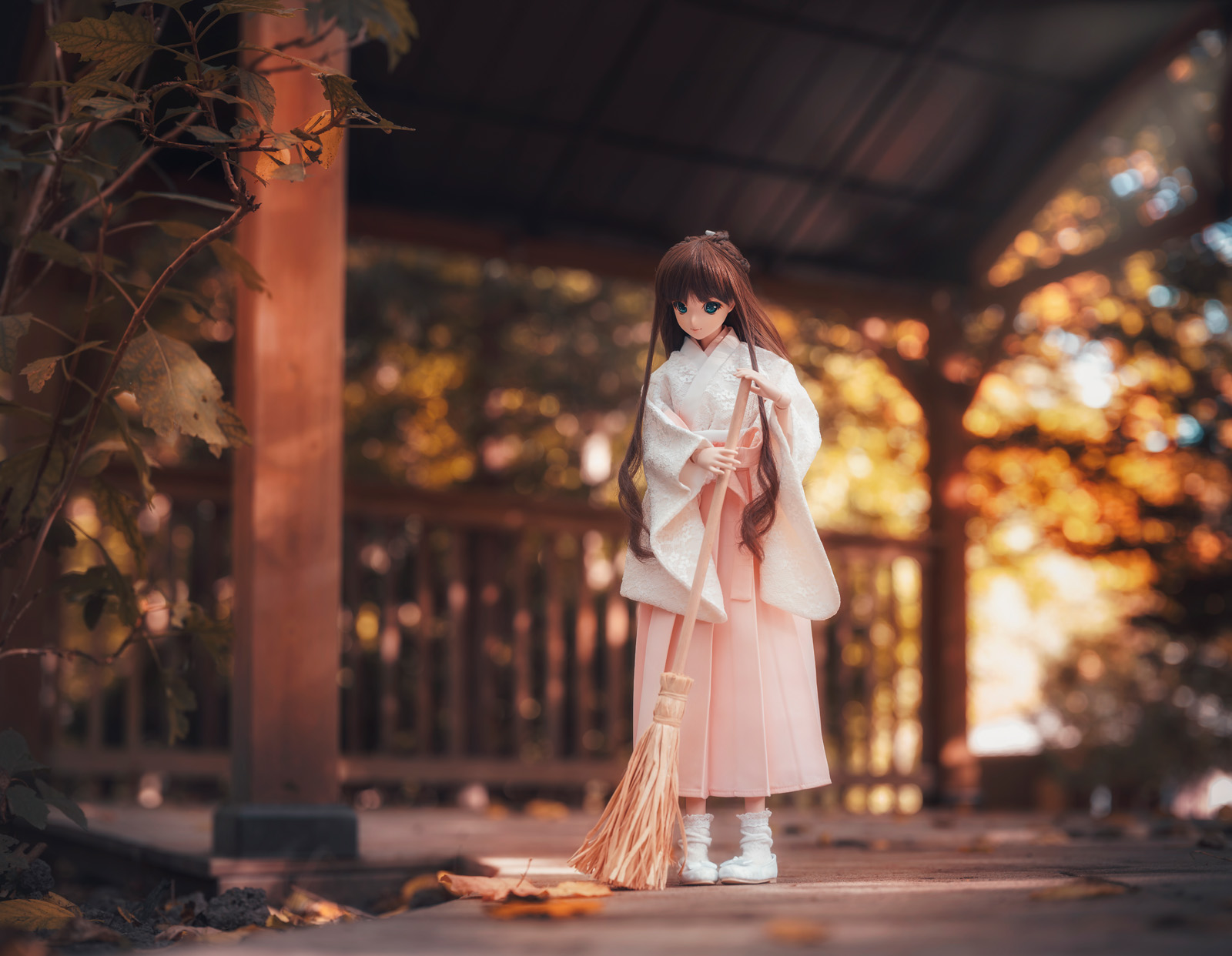
Your images often feel realistic despite the scale of the subject. How do you approach composition and depth to achieve this effect??
First, shout out to Ateens. His articles regarding how to overcome the scale issue are some of the best guides available to doll/figure photographers, especially for those using wide-angle lenses. For my own procedure, I use the benchmark position where portrait photographers put the camera relative to the model, then a little below that benchmark. Alternatively, I start by putting the camera a few centimeters above the ground (can be a bit higher for longer focal lengths or when you are closer to the doll) and then adjust the height and distance until I think everything is OK on the screen. We doll/figure photographers must keep fit because so often we kneel down, crawl, or even lie on our stomachs (laughs). When applicable, I use large apertures to blur out unwanted things in the background that look relatively huge compared to the doll.
Besides scale, I think many other details add up to a sense of realism. For example, I tend to pose my doll in a simple and natural way, i.e., no action or pose that a normal human being cannot or is shy of doing. I also learn a lot from other portrait photographers: their poses, their composition, the interaction between model and environment, and their editing techniques. When I treat my doll like a real person, the outcome somehow becomes more realistic.
Lastly, I’m not trying to make the audience completely mistake the dolls for real people. I would like people to be aware that the subject is a doll and still appreciate it, just like they would appreciate portrait photography. Otherwise, I could simply work with a real model. Close to reality, but still something distinct—that is my idea.
Could you describe your process when creating an image, from the initial idea to the final photograph?
I like to borrow ideas from other forms of art; it could be a cutscene in a movie or anime, a game wallpaper, or an album cover art. Occasionally, I just go out and try my luck, shooting whatever looks nice to me.
On the spot, I do the math: what to add and what to subtract in the composition. Before hitting the shutter, I always evaluate the balance of every major subject, including where to put the objects, the size of each object, the pose of the dolls, and correct exposure. It’s similar to painting – every stroke must be there for a reason, though we photographers have to make more compromises as we cannot arrange everything in the real world.
Then I take several photos, slightly different in exposure and angles, to reduce the risk of unexpected errors that I may realize only after I return home.
Regarding post-editing, I would say the pre- and post-processing each contribute about 50% to the final result. RAW is a top cut steak from a top breed, and Photoshop is the top chef who grills the steak to perfection. I always have a vague idea of the final outcome. Based on it, I evaluate each element in the raw and often adjust, remove, or add elements to complement the composition. In addition, color and light, as mentioned above, are used to highlight the objects that I would like the audience to focus on. I use a variety of tools, techniques, and filters, such as a drawing tablet to finely adjust the color and light, luminosity masks, 3D LUTs, and Nik Collection, to name a few.
When I treat my doll like a real person, the outcome somehow becomes more realistic.
Your photographs are often simple in composition yet very expressive. How do you decide what to include and what to leave out?
Relatively speaking, I am a minimalist. So when an object makes no sense to me, I try my best to remove it, either when I take the photo or in Photoshop. An object that makes sense to me could be something interacting with the main object, balancing the weight of the picture in composition or in color/light, or could be something telling a little side story in addition to the main story of the photo. When possible, I like to leave some blank in my photo, allowing the audience to fill it with their own imagination and understanding.
Seasonal changes seem to be an important element in your work. What role do time and season play in your photography?
Seasons are something I really want to show the audience. I live in Canada, where the notorious winter lasts almost half a year. At the same time, we are also famous for the beautiful fall foliage. Whether people hate it or like it, I consistently photograph blossoms in spring, leaves in fall, and snow in winter. Thanks to how amazing nature is, even after almost ten years of doing this, I never get bored because every year it looks different! To complement this ongoing project, I moved to a house with a large backyard and planted all kinds of plants there – hydrangea, lavender, sunflowers, a maple tree, a sakura tree, among others. I am passionate about exploring the unknown and the changes of seasons every year.
Looking back over the past five years, what has been the most challenging photographic experience for you, and what did you take away from it?
I think the biggest thing in photography is balancing my life, including family, work, other hobbies, and so on, which I think other Figubo members would agree with. Most of us become middle-aged shachiku (roughly “overworked company employees”), and we face all kinds of pressure every day. I may not have enough time to take a photo, or just feel too tired to bring a heavy camera bag and dolls out when there is free time.
And the challenges go beyond time constraints. We started this hobby a long time ago, and we all achieved something during this journey. It is very easy to lose passion and interest if we stay in the same place, with the same figures/dolls, and use the same photography techniques. Actually, all my doll/figure photography buddies outside Figubo have left this hobby. My personal solution is to expose myself to other things. All genres of photography, music, paintings, readings, and anything that interests me. These may not directly affect the next photo I create, but they gradually shape my perceptions and moods, and one day they may become inspiration and motivation for my next photo project. So, I am proud that I am still here shooting on a regular basis, even though I am not so productive anymore. And I am happy to live with all the challenges.
Lastly and most importantly, my wife always supports my hobbies, both financially and emotionally. She has never once said no to any of my expensive hobbies. I am greatly indebted to her.
How do you see your work in the context of exhibitions and printed presentation compared to viewing it online?
I’m an old-school guy in my thirties (laughs). The digitalized world gives us an opportunity to show our work to people on the other side of the planet, which I really appreciate. However, being able to spot every detail of Mona Lisa in a super high-resolution picture online never stops tons of visitors from visiting the Louvre. I own a high-end hi-fi system, but I still get goosebumps at every live concert I attend. I often buy something offline out of impulse, though I know it is cheaper online. The emotional connection, the feeling of myself and the piece of art in the same physical location, the communication with other attendees, all make the exhibition still irreplaceable at the moment. Technically, thanks to the fact that Figubo organizers always print our work in a larger size, the texture, 3D dimensional feeling, color, and light reproduction, and details are much better presented than on a smartphone screen, where most people watch photos now.
Looking ahead, Abuwhobi’s creative ambitions move beyond realism alone, toward images shaped equally by atmosphere, color, and imagination.
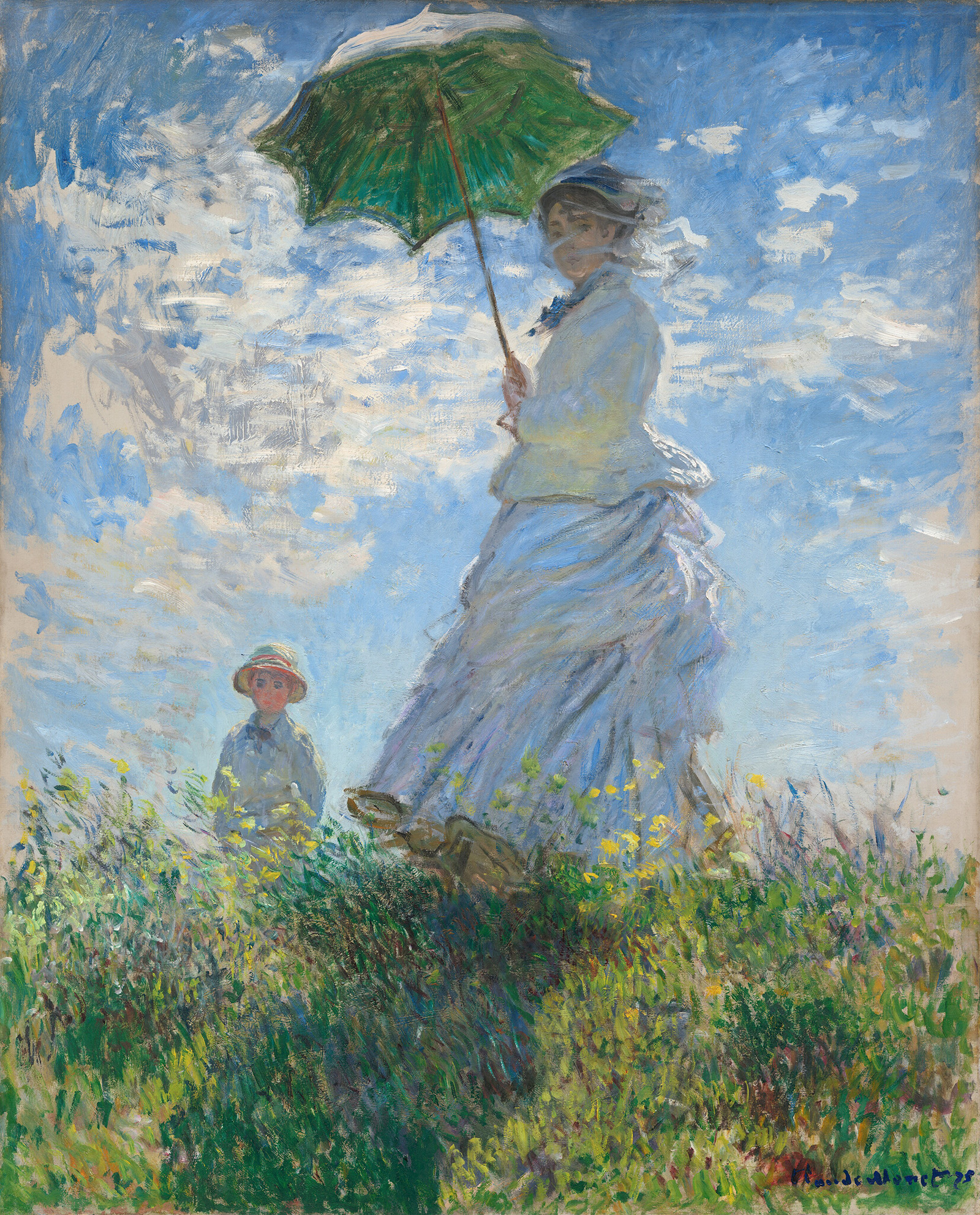
Future directions in the work of Abuwhobi are shaped by a growing interest in art history and visual experimentation. He is particularly inspired by Impressionism, especially the movement’s sensitive use of color, atmosphere, and natural light. Among the paintings he admires most is Woman with a Parasol by Claude Monet — a work whose airy composition and luminous mood he hopes to reinterpret through photography in his own way.
Alongside this painterly influence, he is also interested in moving further toward conceptual photography, where ideas, symbolism, and post-production can play a stronger role. This suggests that his future images may continue to balance realism with imagination, combining carefully observed moments with more expressive visual storytelling.
CLAUDE MONET
Woman with a Parasol – Madame Monet and Her Son, 1875
Courtesy National Gallery of Art, Washington
Claude Monet’s 1875 masterpiece captures his wife Camille and son Jean in a moment shaped by wind, sunlight, and movement. Seen from below, the figures rise against an open summer sky, turning an ordinary family scene into one of Impressionism’s most iconic images.
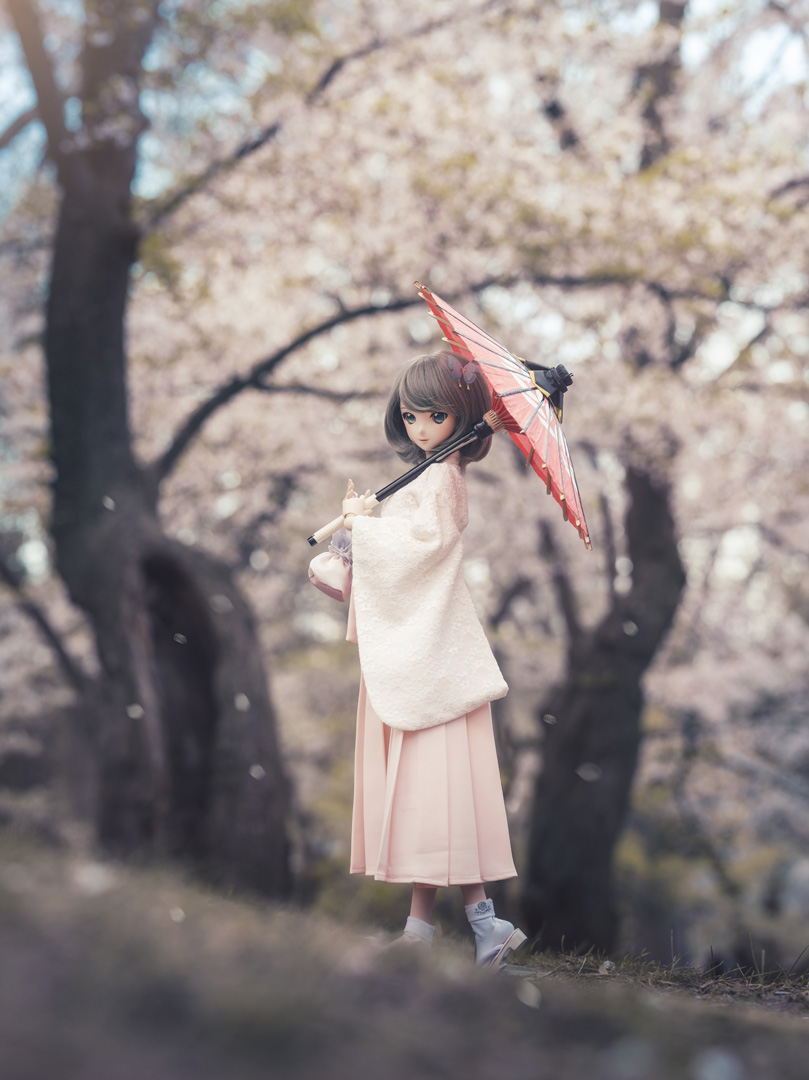
For Abuwhobi, photographing sakura is an annual ritual — a way of capturing the beauty, fragility, and passing nature of spring through atmosphere, color, and emotion.
What was the initial idea, feeling, or image that led to the creation of this photograph?
I keep shooting sakura blossoms every year as part of my idea of capturing seasonal changes. And obviously, a doll in a yukata or a kimono would be a perfect match for the scene. One of my favorite anime is 5 Centimeters per Second, and I am always deeply moved when I see the falling petals. These elements are what I would like to bring together, and I just go ahead and try my luck every spring.
How did you approach the atmosphere and visual tone of this image?
We all love sakura for its purity, elegance, and transience. So I keep the photo with low saturation and relatively high key to reflect this feeling. To avoid the photo becoming too flat and boring, the doll is posed as if walking uphill and holding a red umbrella. Also, it is quite important that the doll is not looking at the camera because I would like to isolate the model from the photographer and the audience. Lastly, I try different apertures and prefer the blurry background to make the atmosphere more dreamy.
What elements were essential in achieving the final result?
Personally, I think all elements make sense in the final photo. In terms of the composition and elements, imagine if the doll does not hold the umbrella, wears a deep red or blue outfit, or is positioned right in front of a tree trunk. During editing, despite the low saturation and high key mentioned above, I changed the color hue of leaves and lawn from fresh green to a very desaturated yellow to keep the tone uniform across the frame. Finally, I added some falling petals as the real falling process is hard to capture. Admittedly, this part is somewhat rough, as I only add a motion filter to all petals while they should be treated with different sizes and blurriness depending on their position and depth. Anyway, I am happy about the final result, and it is so far one of my favorite sakura works.
How do you see this photograph within your overall body of work?
I would say this is a lovely paragraph in my sakura work, which is then part of my spring chapter in the season thesis. (laughs) I think it is consistent with all the characteristics we talked about above, the atmosphere, color, light, composition, just everything.
What does this image represent for you today?
Technically, this photo is a safe piece as it does not involve any newer or different things than what I have done in the past. When I did my PhD, my supervisor always cared about identification as much as about ideas. For over 90% of my photos today, I have tried them in some way before. But still, there is always a way to improve the execution of the same idea. So I am happy that year by year, I might be more and more able to express my feelings and love for sakura, or more broadly, the seasonal changes. And this is just a good example of where I am now.


 Interview: Johnny Director